Nonprofits operate under a permanent constraint that for-profit organizations only face in downturns: the expectation that operational efficiency is not just desirable but morally obligatory. Every dollar spent on administrative overhead is a dollar not spent on the mission, and the donors, foundations, and board members who fund the organization hold it to an efficiency standard that its for-profit counterparts rarely face. The paradox is that meeting that standard requires operational investment. The nonprofit that tries to reduce administrative overhead by using inadequate tools ends up creating more overhead, not less, as staff spend time compensating for the limitations of the tools rather than doing the mission work the organization exists to support. The nonprofits that consistently do more with less have not done it by asking their teams to work harder with worse tools. They have done it by investing in operational infrastructure that reduces the administrative burden of coordination, reporting, and governance to a level that genuinely frees their team’s capacity for the work that donors fund. That infrastructure is built on project management tools that provide enterprise-grade operational capability without enterprise-grade cost or complexity.
Program and beneficiary tracking that does not require a database administrator with Lark Forms
The intake process for nonprofit programs, whether it is a social services referral, a grant application, a volunteer registration, or a beneficiary enrollment, is one of the highest-volume administrative activities in most nonprofits and one of the least well-supported by the tools typically available to them. Paper-based intake creates manual data entry burden. Email-based intake creates information management chaos. Specialist case management systems create cost and complexity that many nonprofits cannot sustain.
Lark Forms provides a structured intake layer that any nonprofit staff member can create and manage without technical expertise. Conditional logic within forms adapts the intake experience to the type of program and the characteristics of the participant, ensuring that every submission arrives with the complete information the program team needs without requiring the participant to navigate a generic form that asks for information irrelevant to their situation. Every submission maps directly into a Lark Base program database as a structured record without a manual data entry step, so the program team’s operational picture is always current and the administrative burden of intake is reduced to the minimum technically possible.
Program operations that are visible without a dedicated reporting role with Lark Base
Nonprofit program management requires a level of reporting that most program teams find onerous: funders want output metrics, boards want impact data, and leadership wants operational visibility, all of which have to be assembled from operational records that were never designed to generate reports automatically. The program coordinator who spends Friday afternoon generating reports is a program coordinator who is not doing program work on Friday afternoon.
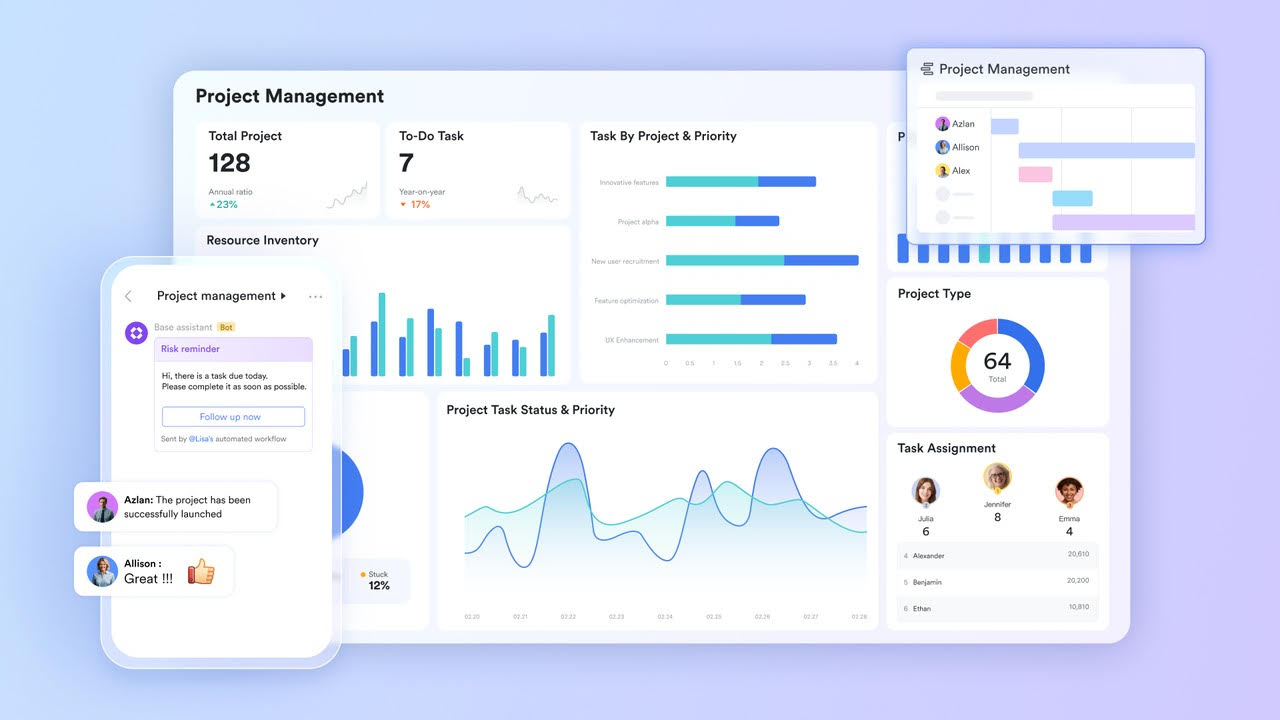
- Shared dashboards give every relevant stakeholder, board members, funders, and program leadership, a live view of program metrics without a coordinator having to prepare a separate report for each audience.
- Automated notifications trigger when program targets are approaching, when beneficiary records require follow-up, or when a program element has been inactive beyond a defined threshold, so the program team is alerted to operational issues proactively rather than discovering them in the next board report.
- Gallery view displays beneficiary profiles and program assets as a visual grid that program staff can review and manage without navigating a complex database interface, making the operational system accessible to the full program team regardless of technical sophistication.
- Real-time data in shared Lark Base tables allows grant managers to verify impact metrics against funder requirements at any point in the grant period rather than assembling the verification data at the end of the period when inaccuracies are hardest to correct.
Institutional knowledge that survives staff turnover with Lark Wiki
Nonprofit organizations typically have higher staff turnover than their for-profit counterparts, partly because of compensation constraints and partly because the mission-driven work that attracts staff members is also the kind of work that creates burnout. The institutional knowledge that leaves with every departing staff member, the program practices, the funder relationships, the community connections, is one of the most significant and least quantified costs of nonprofit staff turnover.
- “Advanced Search” with powerful filters allows every staff member to find any program documentation, funder relationship record, or community partnership detail in seconds, so the organization’s institutional knowledge is accessible to every team member rather than concentrated in the memories of the longest-serving staff.
- “Permission Settings” at the user and department level allow sensitive program records and confidential beneficiary information to be protected appropriately while keeping general program knowledge accessible to the full team.
- “Migration” from Confluence, Word, Excel, and other formats allows nonprofits with years of accumulated program documentation to bring that knowledge into a structured, searchable knowledge base without rebuilding from scratch.
Grant and compliance approvals that satisfy funders without administrative burden with Lark Approval
Nonprofit governance requirements are extensive and the consequences of non-compliance are severe: grants can be clawed back, organizational status can be jeopardized, and reputational damage can affect future funding relationships. The approval processes that satisfy these requirements often generate significant administrative overhead that competes with program delivery for staff time.
- “Conditional Branches” route different categories of expenditure, program commitment, and compliance decision to the appropriate board, executive, or committee authority automatically, so the governance framework operates without requiring a dedicated compliance coordinator to direct each approval through the correct channel.
- Full approval history provides the audit trail that grant reporting, board oversight, and regulatory compliance require without a separate compliance system that adds to the administrative burden of program delivery.
- “Auto-delegation” ensures that the governance structure continues to function during board member absences and executive transitions without creating a backlog that delays program operations or creates compliance gaps.
Volunteer coordination that does not require a dedicated coordinator with Lark Messenger
Volunteer management is one of the most labor-intensive administrative activities in nonprofit operations. Coordinating the schedules, communications, and assignments of a large volunteer network requires significant staff time that many nonprofits can ill afford to allocate to coordination rather than program delivery.
- Lark Messenger allows nonprofits to create group chats and topic groups for different volunteer cohorts, program sites, or event teams, helping conversations stay relevant to specific groups. Group owners can manage permissions within each chat, making it easier to coordinate volunteers and staff without relying on a single large communication channel.
- “Scheduled Messages” allow the nonprofit to send volunteer briefings, schedule reminders, and program updates to every relevant volunteer group at appropriate times without staff members having to compose and send each communication manually during the already demanding periods before major program activities.
- “Real-time Auto Translation” across 24 languages supports nonprofits with diverse volunteer communities who communicate in multiple languages, allowing the organization to maintain a single communication environment rather than separate channels for different language groups.
Bonus: Why operational efficiency is the highest-leverage investment a nonprofit can make
The nonprofit that treats operational tools as a cost to be minimized rather than an investment to be optimized consistently underperforms its potential. Every hour of administrative overhead eliminated by better operational infrastructure is an hour that returns to program delivery. At scale, the return on operational infrastructure investment in a nonprofit context often exceeds the return on program expansion because it amplifies the capacity of the existing team rather than adding to the headcount that drives cost.
Platforms like Salesforce Nonprofit and Bloomerang provide specialist nonprofit CRM functionality. Asana and monday.com provide project management. But neither addresses the full administrative burden of nonprofit operations: the intake, the program tracking, the knowledge management, the governance, and the volunteer coordination, in a way that a small nonprofit team can implement and maintain without specialist technical support. Looking at Google Workspace pricing as a base and adding those specialist tools creates a system that most nonprofits cannot afford and cannot maintain. Lark provides the operational infrastructure that large nonprofits need at a cost structure that smaller nonprofits can sustain.
Conclusion
Nonprofits do more with less, not by working harder with inadequate tools, but by working smarter with operational infrastructure that handles the administrative burden of coordination, tracking, knowledge management, governance, and volunteer communication automatically. A connected set of productivity tools that reduces the administrative cost of program delivery to the minimum possible is how nonprofits maximize the proportion of every donated dollar that reaches the mission rather than being consumed by the operational overhead of delivering it.