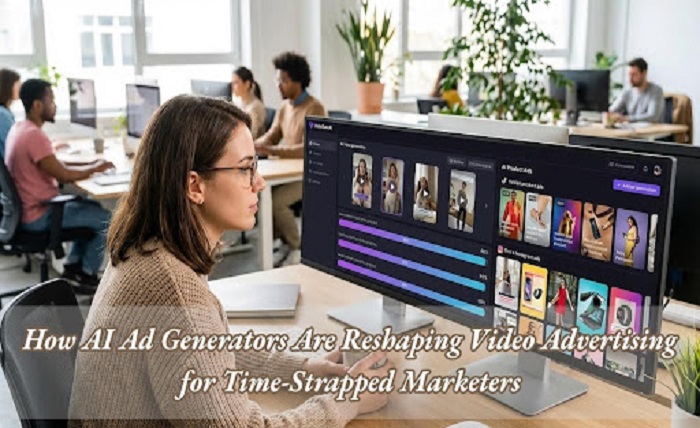
Picture this: It’s Thursday afternoon, and your client needs five different video ad variations for a product launch on Monday. Traditional video production would require a creative brief, a production team, days of editing, and a budget that makes your finance director wince. Yet here you are, expected to deliver scroll-stopping content that performs.
This scenario isn’t unusual—it’s become the norm for modern marketers navigating the relentless demand for fresh video content across social platforms.
The advertising landscape has shifted dramatically toward short-form video. TikTok, Instagram Reels, and YouTube Shorts now dominate user attention, but producing quality video ads at scale remains prohibitively expensive and time-consuming for most businesses. Enter the ai ad generator: a technology that’s quietly transforming how brands create video advertising. These AI-powered tools are democratising creative production, enabling marketers to generate professional-grade video content without film crews, expensive software, or specialised design skills.
This article explores how AI ad generation technology works, where it’s making the biggest impact, and what the future holds for automated creative production.
What Is AI Ad Generator Technology?
An ai ad generator is software that uses artificial intelligence to automate the creation of advertising content, particularly video ads. Rather than starting with blank templates or hiring production teams, marketers input basic parameters—product details, target messaging, brand colours—and the system generates completed ad concepts, often within minutes.
How It Works (Light Technical Overview)
The technology behind an AI video ad maker combines several machine learning approaches. At its core, these systems are trained on vast databases of successful advertising campaigns, learning patterns about what visual sequences, messaging structures, and creative elements tend to perform well across different industries and platforms.
Most AI ad video generator tools follow a similar sequential process:
- Input: Users provide text inputs describing their product or message and select stylistic preferences.
- Assembly: The system assembles video components accordingly. These components might include stock footage, animated graphics, text overlays, and transitions—all choreographed by algorithms trained to create coherent narratives.
- Enhancement: More advanced platforms incorporate AI avatar technology, where synthetic presenters deliver scripted content with surprisingly natural gestures and expressions. Meanwhile, AI voiceover capabilities convert written scripts into spoken audio across multiple languages and vocal styles.
Why It Matters for Modern Advertisers
The adoption of AI tools isn’t just about novelty; it addresses critical bottlenecks in modern marketing workflows:
- Speed: Speed represents the most immediate benefit. What once required days or weeks now takes minutes. A marketing manager can generate multiple ad variations during a coffee break, test them that afternoon, and scale the winners by evening.
- Cost Efficiency: Cost efficiency follows closely behind. Traditional video production might cost hundreds to thousands of pounds per asset. An ai ad generator subscription typically runs £50-200 monthly for unlimited creations—a transformative economic shift for small businesses and lean marketing teams.
- Accessibility: You don’t need Adobe expertise or design training. If you can describe what you want, these tools can build it. This democratisation means the solo entrepreneur in Manchester competes visually with the London agency’s clients.
- Scalability for Testing: Performance marketing thrives on iteration—trying different hooks, call-to-action phrases, or visual approaches to identify AI winning ads. Generating ten variations manually might be impractical; with AI tools, it’s standard practice.
Practical Use Cases of AI Ad Generators
E-commerce Product Launches
Consider an online fashion retailer preparing for their spring collection launch. They need video ads showcasing fifteen different products across Instagram, Facebook, and TikTok—each platform requiring different aspect ratios and durations.
Using an AI video ad maker, their small marketing team uploads product images, writes brief descriptions, and selects on-brand music. Within an hour, they’ve generated forty-five ad variations (three per product). Half employ polished product showcases; the others mimic UCG video aesthetics—that raw, user-generated content style that often outperforms overly polished creative on social platforms. They launch all variations with modest budgets, let performance data accumulate over 48 hours, then reallocate spend toward the top performers.
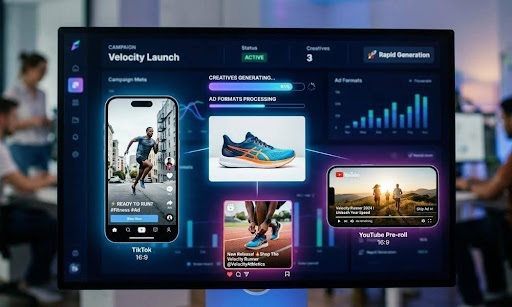
Social Media Campaign Scaling
A digital marketing agency manages twelve client accounts, each requiring consistent content across multiple platforms. Their challenge isn’t creating one brilliant ad—it’s producing dozens of competent ads weekly without burning out their creative team.
They implement an AI ad video generator as part of their workflow. Junior team members handle initial generation based on client briefs, whilst senior creatives focus on strategy and refining the AI outputs that show promise. The tool handles technical grunt work—resizing for different platforms, adding captions, syncing music—freeing humans for higher-value creative thinking. The result is augmented capacity: the agency increases output by 60% without additional hires.
Localised Advertising for International Markets
A UK-based software company expands into France, Germany, and Spain simultaneously. Previously, they’d need local agencies in each market to produce culturally appropriate video ads—a coordination nightmare.
Instead, they use an AI voiceover system that converts their core ad scripts into native French, German, and Spanish audio, paired with AI avatar presenters whose appearance and mannerisms can be adjusted for cultural resonance. They create market-specific variations in days rather than months, at roughly one-tenth the traditional cost, maintaining brand consistency whilst accommodating local nuances.
Performance Marketing and Iteration
A direct-to-consumer brand runs Facebook ad campaigns where creative fatigue sets in quickly—audiences tire of seeing the same ad, and performance degrades. Their solution requires constant creative refreshment.
They establish a systematic approach using AI tools: every Monday, they generate twenty new ad concepts testing different hooks, visual styles, and messaging angles. Mid-week performance reviews identify AI winning ads, which then receive increased budgets. Underperformers are paused, and new variations are generated to replace them. This continuous creation-and-testing cycle keeps their campaigns fresh and maintains cost-per-acquisition below target thresholds.
Small Business Video Marketing
An independent bakery in Bristol wants to build an Instagram presence but lacks the budget for professional videography. The owner uses an AI video ad maker to create weekly promotional content: new product announcements, behind-the-scenes snippets, and special offers.
She simply describes each video concept in plain English, selects appropriate visual styles from templates, and adds her logo. The AI voiceover feature narrates product descriptions in a warm, inviting tone. Within twenty minutes weekly, she produces content that looks professionally produced—helping her small business feel legitimate in digital spaces previously dominated by bigger competitors.
Tools Supporting This Workflow
The ai ad generator landscape has expanded considerably, offering various approaches to automated creative production.
Two Main Categories:
Broadly, tools fall into two categories. Template-based platforms provide structured frameworks for customisation. These excel at speed and consistency, typically offering extensive libraries of pre-designed ad formats optimised for specific industries (like e-commerce or SaaS).
Conversely, generative AI platforms employ more sophisticated models that compose video sequences with greater originality from scratch based on text descriptions. Platforms combining multiple AI technologies—such as AI avatar presenters, AI voiceover narration, and automated b-roll selection—offer particular versatility.
Key Features to Evaluate:
- When choosing a tool, look for these essential capabilities:Access to stock media libraries (footage and music).
- Voiceover options including both AI-generated and human recordings.
- Avatar customisation for brand alignment.
- Export formats compatible with major advertising platforms.
- Collaboration features for team workflows.
- Integrated performance analytics that track how AI-generated ads perform across channels.
- Some integrated systems represent where the technology is heading: not just generating ads, but generating AI winning ads based on predictive performance modelling.
Future Trends in AI Ad Generation
The trajectory of ai ad generator technology points toward several emerging capabilities that will further reshape advertising creation.
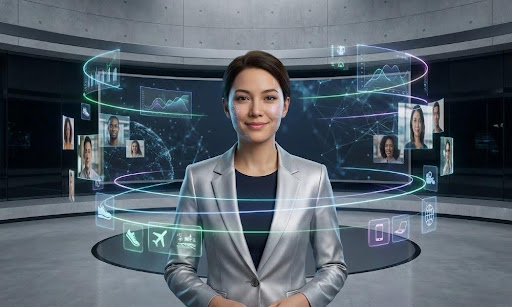
alt: Future Trends in AI Ad Generation
- Hyper-personalisation: This represents perhaps the most significant evolution. Rather than creating one ad for thousands of viewers, future systems will generate individualised variations dynamically—adjusting messaging, visuals, and offers based on viewer demographics, browsing history, or current context.
- Real-time ad generation: Based on trending topics and cultural moments, this will enable brands to participate in conversations as they unfold. When a news event or viral meme emerges, AI systems could generate relevant, on-brand ad content within hours.
- Integration with e-commerce platforms: This will streamline product video creation further. As inventory updates, AI systems could automatically generate fresh ad creative featuring new arrivals or highlighting stock that needs movement.
- Enhanced AI Avatar Realism: Current synthetic presenters sometimes occupy an uncanny valley; near-future versions will be indistinguishable from human talent in most contexts. This raises important questions about ethics and transparency standards regarding disclosure when AI avatars are used.
- Predictive performance modelling: This may ultimately prove most valuable: AI systems that analyse ad concepts before launch and accurately forecast performance metrics. Rather than testing everything, marketers could focus resources on concepts the AI predicts will succeed.
Conclusion
The ai ad generator represents more than workflow efficiency—it’s a fundamental shift in who can create professional advertising and at what scale. By addressing genuine pain points in modern marketing—time pressure, budget constraints, platform complexity, constant content demand—these tools are democratising creative production in meaningful ways.
This technology isn’t about replacing human creativity; it’s about augmenting human capacity. The best results emerge when marketers combine AI’s speed and scalability with human strategic thinking, brand understanding, and creative intuition. The AI video ad maker handles production mechanics whilst humans focus on messaging strategy, audience insights, and creative concepts that algorithms haven’t yet imagined.
For businesses of all sizes, these tools are worth exploring—not as complete solutions, but as powerful additions to existing creative processes. As the technology continues improving rapidly, the gap between imagining an ad concept and seeing it perform in market will shrink to near-zero.